Stop waiting on clients to close.

The books can’t close because a client hasn’t answered about six transactions. We build the systems that ask the right questions, chase what is missing and keep each month moving, so your team can take on more clients without more admin.

Find my blind spots
Jay AwalJay Awal · Founder and Systems Architect

Example: a client has open items at month-end

Where a bookkeeping firm loses its month.

Example screen

Clients who don’t answer

Your team sends a list of uncategorized transactions, the client ignores it, and the close waits while someone follows up again.

The same documents, every month

Statements and receipts get chased by hand for every client, every month, one email at a time.

A close that lives in one head

Who is done, who is stuck and who is waiting on what sits in a spreadsheet or in your memory. You can’t take a week off at month-end.

Work you never bill for

Catch-up work and extra requests get done and never make it onto your own invoice.

Onboarding by email

Bank access, prior books and accounts get collected over weeks of back and forth before the real work can start.

Price conversations you avoid

Scope grows, and nobody wants the awkward talk about raising the fee, so the extra work stays free.

Meet your close chaser.

It asks only what is missing, keeps asking, and tells your team when a person should step in. An example from month-end. Your firm approves every message and sets the schedule.

  1. 1st of the monthEach client gets a short list of only what your team needs from them.
  2. Partly answeredThe system sees four of six items are done and asks only about the last two.
  3. Client goes quietReminders continue on your schedule, then a person on your team gets a task to reach out.
  4. All inThe client moves to ready to close, and your bookkeeper picks up complete work.

What month-end chasing and slow replies cost your firm this year.

Set it to match your business. Nothing is saved or sent. Sales and hours are counted separately.

A new lead hears back
Sales at risk from slow replies
$0
a year, estimated
Busywork that could run on its own0
What those paid hours cost you$0
Find my top 3 blind spots
How we calculate this

Sales at risk = leads a month × your close share × average value × 12 months × the share lost at your reply speed (0%, 30%, 55% or 70%, our planning assumptions). Busywork = 60% of your weekly hours at $35 an hour for 50 weeks. These are estimates, not promises.

Jay Awal, Founder and Systems Architect

Built by an owner, for owners.

Jay Awal has been the owner doing everything by hand at midnight. He started DispatchCo to build owner-run businesses the same kinds of systems his own businesses run on.

  • We run on it first. Jay's own businesses run on DM replies, follow-up and content systems like the ones on this page.
  • We teach it. 30+ stages, plus an AI build cohort for owners.
  • We show up. Every build starts hands-on with our team.

What we usually build first.

Month-end chasing

Personal lists and reminders that only ask for what is still missing.

Close tracking

One board shows every client, their status and what is holding them up.

Your own billing

Extra work gets logged as it happens, so it makes it onto your invoice.

Client onboarding

One clean path for access, prior books and your engagement letter.

Firms often run QuickBooks Online or Xero, with Karbon, Financial Cents or Double on top. We check how your software connects before we quote, and we keep sensitive files in the tools you already trust.

Who owns each job, before and after.

Your bookkeepers keep the judgment. The chasing moves.

The jobTodayAfter
Getting answers on transactionsBookkeeper, in a spreadsheetSent to clients, answers logged
Requesting statements and receiptsStaff, one email at a timePersonal list with reminders
Tracking the closeSpreadsheet or memoryOne board for every client
Billing extra workDone, never invoicedLogged as it happens, added to the invoice
New client setupWeeks of emailOne guided path
Review and sign-offYour bookkeepersYour bookkeepers, always

The rules we build around.

A person reviews the books

Your bookkeeper signs off. Nothing gets posted to a client’s books without the review steps you set.

Client financial data

We keep it inside tools your firm has cleared, and walk you through each vendor and its terms.

Your security plan

If you handle tax work, you need a written information security plan. New systems get reviewed against yours.

Plan it. Build it. Teach it. Pick one or all three.

Every system comes with training for the people who run it.

Blueprint

Know what to build first and what it's worth.

For owners who want to know where AI pays off first.

  • Maps your month from statements to sign-off
  • Your AI org chart: your team plus the agents beside them
  • A ranked plan with the dollar value of each fix
Start with the audit

Credited toward your Deployment

Deployment

Your first system running in 30 days.

For owners who want it built and running.

  • Playbooks written first, then automated
  • Connects reminders, questions and status to your practice tools
  • Your team trained to run it without you
Find my blind spots

Scoped from your Blind Spot Audit

Workshop

Your team builds its own agents on real work.

For teams that need to use AI every day.

  • In person, at your office
  • Your staff learn it on real client files
  • Scored before and again at 60 days
Start with the audit

Scoped from your Blind Spot Audit

No surprises. You see the full scope and price before any work starts.

Inside a real build.

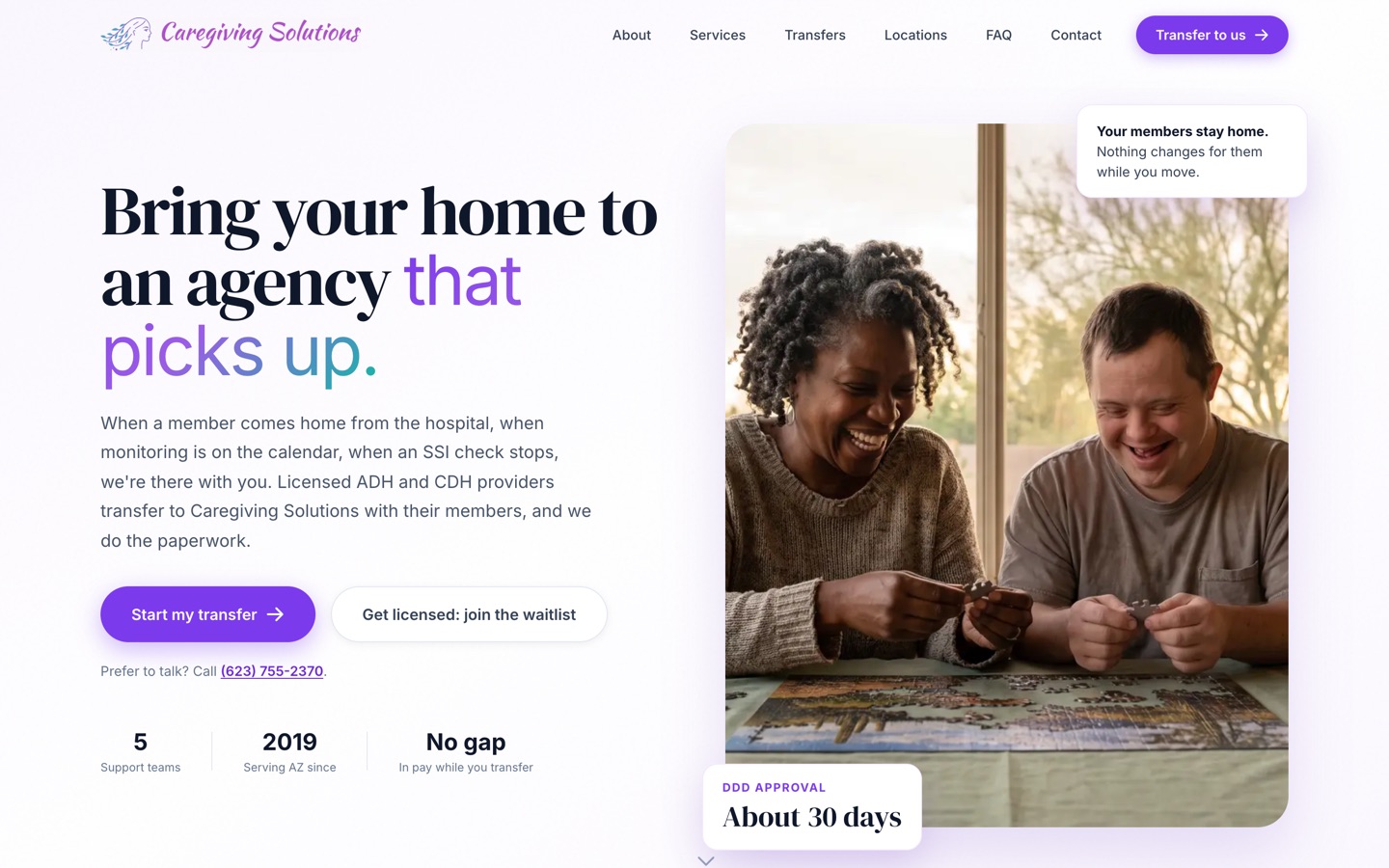
Our published case study is a care agency, not a bookkeeping business. The problem was the same: work sat waiting for someone to send the next step. We moved their forms online and built a back end that sends it on its own. Licensing went from about 6 months to under 90 days, depending on the state agency.

See the Caregiving Solutions build
The current Caregiving Solutions homepage

Three steps. First system live in 30 days.

Today · 3 minutes

Take the Blind Spot Audit

10 questions. See your score and top 3 blind spots right away.

Start my audit
This week · 30 minutes

Walk through it with Jay

30 minutes on Zoom. We go over your report, check the numbers and agree on the first fix.

Day 30

We build it with your team

Biggest blind spot first, with your people trained to run it. The next system follows by day 90.

We don't start strong and disappear.

  • Every build starts hands-on with our team. We build alongside your people from week 1 to launch.
  • You hear from us every week. A 30-minute check-in for the length of the build.
  • You see the number. We time the jobs in week 1, both sign it, and time them again at day 90.
  • You keep everything. Every system, login and document stays yours. Stop anytime.

10 hours a week back by day 90, or we build one more system free.

For Deployment clients. The extra system is no bigger than the smallest one in your Deployment, and it's delivered within 30 days.

  • How we measure itIn week 1 we time the jobs we're automating with you, and we both sign that number. At day 90 we time them again the same way.
  • Your partThe week-1 timing, fast access and approvals, the weekly check-in, and running the work through the systems. Full terms are in the FAQ.

What a good month-end looks like by day 90.

Clients answer sooner

Open items shrink without staff chasing.

You can see the close

Every client has a status and a next step, so it does not live in one head.

Room for more clients

Admin stops being the limit on your growth.

Questions owners ask.

Is this different from what QuickBooks already does?

Your software handles the bank feeds and categories. The time usually goes to chasing clients and tracking who is done, and that is the part we build.

Will my clients actually respond?

Clients answer what is simple. A short personal list and a quick reply beat a long portal login, and reminders do the rest.

We are a two-person firm. Does this make sense?

It can, especially if you are turning clients away because of admin. The 3-minute Blind Spot Audit shows whether it would pay at your size.

What if it gets something wrong?

It only does what your rules allow, and your team can see and change everything. We test against your real situations before it goes live, and we watch it closely in the first weeks.

Will AI categorize transactions for us?

Your software may already suggest them. We focus on getting answers from clients, and any AI suggestions still pass through your bookkeeper’s review.

I have paid vendors before and got nothing. Why is this different?

You own every system, login and document. You see the work at a weekly check-in, and you can stop anytime and keep what is built. Deployment clients also get a written guarantee, measured against a baseline we both sign in week 1.

What does it cost?

It depends on what we build, so we scope it from your Blind Spot Audit and a call. A 6-person shop and a 60-person company need different things. You see the full scope and price before any work starts.

Will my team actually use it?

We build it inside the software they already log into, write the playbooks with them and train them on their own real work. People use what they helped shape.

How much of my time does this take?

About 30 minutes a week to approve things and tell us what's off. You know your business, we know the build.

Am I locked in?

No. Blueprint, Deployment and Workshop are separate decisions. Stop after any of them and keep everything we made.

How does the 10-hour guarantee work?

It comes with every Deployment. In week 1 we time the jobs we're automating with you and we both sign that number. At day 90 we time them again the same way. If your team isn't saving 10 hours a week, we build one more system free, no bigger than the smallest one in your Deployment, within 30 days. It applies when you've done your part: the week-1 timing, access within 5 business days, the weekly check-in, playbook approvals within 3 business days, and running the work through the systems.

See what to take off your plate first. It takes 3 minutes.

The Blind Spot Audit shows where AI and systems would save you the most time and money. See your score and top 3 blind spots right away.

10 questionsResults right away

Find my blind spots10 questions · Results right away