Quotes go out. Nobody follows up.

The estimate leaves the truck and nobody has time to circle back. We build the systems that chase quotes, ask for reviews and keep the board moving, inside the software you already run.

Find my blind spots
Jay AwalJay Awal · Founder and Systems Architect

Example: a furnace quote, two days later

Where the money slips out of a service business.

Example screen

Quotes nobody chases

The estimate leaves with the tech and nobody has time to circle back. A big replacement quote sits for weeks while the homeowner collects two more bids.

Customers you never see again

You fixed their furnace two years ago and never reminded them about a tune-up. Next time something breaks, they search and book whoever shows up first.

Everything runs through you

Pricing questions, schedule changes and upset customers all land on your cell. You can’t take a day off without the board falling behind.

A dispatcher doing five jobs

One person moves the board, texts techs, sends “on the way” updates and calms down customers. When that person is out sick, the whole day wobbles.

Reviews nobody asks for

Happy customers would leave a review if someone asked. The ask depends on a tech remembering in the driveway, and it slips.

Web leads waiting on a reply

Form fills, texts and Facebook messages come in while everyone is on a job. By the time someone writes back, they booked another company.

Meet your quote follow-up.

The estimate leaves the truck. The follow-up keeps going until the homeowner books or says no. An example of the first system most service companies should look at. Your timing, wording and rules go in before it ever texts a customer.

  1. Quote dayYour tech leaves a replacement quote with the homeowner and marks it sent in your field software.
  2. Two days laterThe homeowner gets a short text in your wording: any questions before you decide?
  3. Still quietA second note goes out on your schedule, offering a time for your estimator to stop by and walk through the options.
  4. They replyThe sequence stops the moment they answer. The visit lands on the board, or the question goes to your estimator with the full history.

What slow follow-up and busywork cost your shop this year.

Set it to match your business. Nothing is saved or sent. Sales and hours are counted separately.

A new lead hears back
Sales at risk from slow replies
$0
a year, estimated
Busywork that could run on its own0
What those paid hours cost you$0
Find my top 3 blind spots
How we calculate this

Sales at risk = leads a month × your close share × average value × 12 months × the share lost at your reply speed (0%, 30%, 55% or 70%, our planning assumptions). Busywork = 60% of your weekly hours at $35 an hour for 50 weeks. These are estimates, not promises.

Jay Awal, Founder and Systems Architect

Built by an owner, for owners.

Jay Awal has been the owner doing everything by hand at midnight. He started DispatchCo to build owner-run businesses the same kinds of systems his own businesses run on.

  • We run on it first. Jay's own businesses run on DM replies, follow-up and content systems like the ones on this page.
  • We teach it. 30+ stages, plus an AI build cohort for owners.
  • We show up. Every build starts hands-on with our team.

What we usually build first.

Quote follow-up

Open estimates get a text sequence in your wording that stops the moment the customer replies or books.

Tune-up and plan reminders

Past customers hear about tune-ups and maintenance plan renewals at the right time of year.

Review requests

A closed job sends the review ask, with a link to your Google profile.

Fast replies to web leads

Forms, texts and messages get a reply and a booking link while your team is out on jobs.

Service companies often run ServiceTitan, Housecall Pro or Jobber. We build around what you have and check how it connects before we quote the work.

Who owns each job, before and after.

Your dispatcher stays. What changes is how much lands on one person.

The jobTodayAfter
Following up on estimatesWhoever remembersText sequence follows up, your estimator closes
Tune-up and plan remindersNobody, until the slow seasonSent on schedule to past customers
Replying to web forms and textsDispatcher, between everything elseReply and booking link, dispatcher checks the board
Sending “on the way” textsDispatcher, when there is timeAutomatic from the job status
Review requestsTech, if they rememberAutomatic when the job closes
Pricing exceptions and upset customersOwnerOwner, with full notes attached

The rules we build around.

Text consent

Automated texts need the right consent. We set up the wording and the record of it before anything sends.

A person on anything risky

Gas smells, water near electrical and anything unsafe go straight to a human, using your rules.

No made-up prices

It only quotes what you approve. Anything else gets booked for a visit.

Plan it. Build it. Teach it. Pick one or all three.

Every system comes with training for the people who run it.

Blueprint

Know what to build first and what it's worth.

For owners who want to know where AI pays off first.

  • Maps every call, quote and job handoff in your shop
  • Your AI org chart: your team plus the agents beside them
  • A ranked plan with the dollar value of each fix
Start with the audit

Credited toward your Deployment

Deployment

Your first system running in 30 days.

For owners who want it built and running.

  • Playbooks written first, then automated
  • Connects phones, booking and follow-up to your field software
  • Your team trained to run it without you
Find my blind spots

Scoped from your Blind Spot Audit

Workshop

Your team builds its own agents on real work.

For teams that need to use AI every day.

  • In person, at your office
  • Your office team and techs learn it on real jobs
  • Scored before and again at 60 days
Start with the audit

Scoped from your Blind Spot Audit

No surprises. You see the full scope and price before any work starts.

Inside a real build.

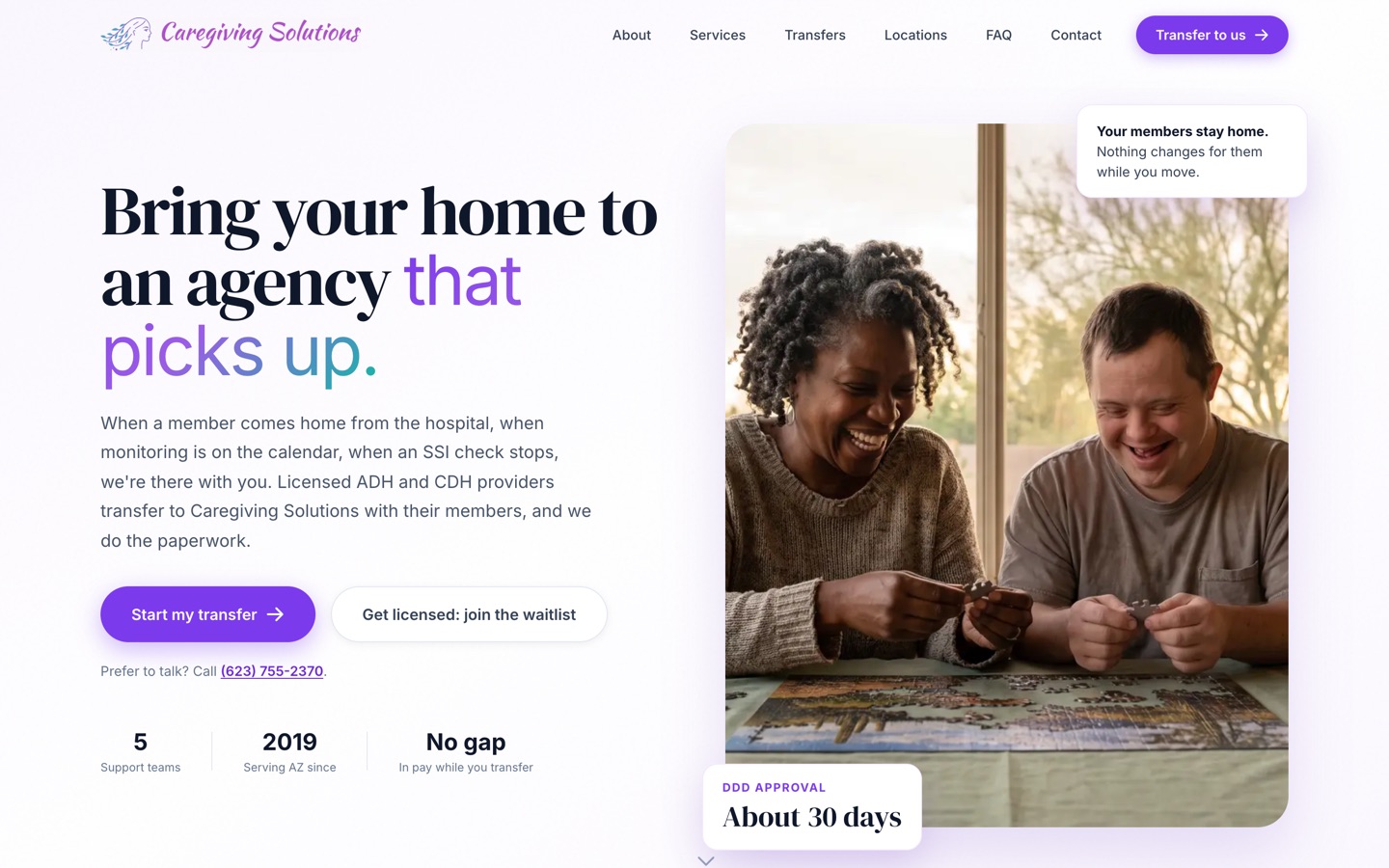
Our published case study is a care agency, not a home service business. The problem was the same: work sat waiting for someone to send the next step. We moved their forms online and built a back end that sends it on its own. Licensing went from about 6 months to under 90 days, depending on the state agency.

See the Caregiving Solutions build
The current Caregiving Solutions homepage

Three steps. First system live in 30 days.

Today · 3 minutes

Take the Blind Spot Audit

10 questions. See your score and top 3 blind spots right away.

Start my audit
This week · 30 minutes

Walk through it with Jay

30 minutes on Zoom. We go over your report, check the numbers and agree on the first fix.

Day 30

We build it with your team

Biggest blind spot first, with your people trained to run it. The next system follows by day 90.

We don't start strong and disappear.

  • Every build starts hands-on with our team. We build alongside your people from week 1 to launch.
  • You hear from us every week. A 30-minute check-in for the length of the build.
  • You see the number. We time the jobs in week 1, both sign it, and time them again at day 90.
  • You keep everything. Every system, login and document stays yours. Stop anytime.

10 hours a week back by day 90, or we build one more system free.

For Deployment clients. The extra system is no bigger than the smallest one in your Deployment, and it's delivered within 30 days.

  • How we measure itIn week 1 we time the jobs we're automating with you, and we both sign that number. At day 90 we time them again the same way.
  • Your partThe week-1 timing, fast access and approvals, the weekly check-in, and running the work through the systems. Full terms are in the FAQ.

What a good Monday looks like by day 90.

Every estimate has a next step

You can see what is open, how old it is and what happens next, without asking anyone.

Slow season gets filled

Past customers hear about tune-ups and maintenance plans at the right time.

Your cell stops being the office

Routine updates and reminders go out on their own, so fewer questions land on you.

Questions owners ask.

Will customers know the texts are automated?

That is your call within the law, and some states require disclosure. We recommend being upfront. Every message uses your wording, and you read them all before anything goes live.

Do I need to switch from ServiceTitan or Jobber?

No. The goal is to make the software you already pay for do more. If something cannot connect, we tell you during the Blueprint, before you pay for a build.

We are a small shop. Is this overkill?

Usually the smaller the crew, the more an unchased quote costs, because the owner is often the one on the job and nobody else follows up. The Blind Spot Audit shows whether it would pay for your size.

What if the system books something wrong?

It only books what your rules allow, and your dispatcher can see and change everything. We test against your real job types before it goes live, and we watch it closely in the first weeks.

Does it work with emergency and on-call rotations?

Yes, that is built from your actual rotation. Your rules decide what counts as an emergency, and anything urgent that comes in by text or web form goes straight to the person on call.

I've been burned by a vendor before. Why is this different?

Every build starts hands-on with our team, and you get a 30-minute check-in every week for the length of the build. Everything is built in your own accounts. We time the jobs in week 1 and again at day 90, so you see the result in hours, and you can stop anytime and keep what's built.

What does it cost?

It depends on what we build, so we scope it from your Blind Spot Audit and a call. A 6-person shop and a 60-person company need different things. You see the full scope and price before any work starts.

Will my team actually use it?

We build it inside the software they already log into, write the playbooks with them and train them on their own real work. People use what they helped shape.

How much of my time does this take?

About 30 minutes a week to approve things and tell us what's off. You know your business, we know the build.

Am I locked in?

No. Blueprint, Deployment and Workshop are separate decisions. Stop after any of them and keep everything we made.

How does the 10-hour guarantee work?

It comes with every Deployment. In week 1 we time the jobs we're automating with you and we both sign that number. At day 90 we time them again the same way. If your team isn't saving 10 hours a week, we build one more system free, no bigger than the smallest one in your Deployment, within 30 days. It applies when you've done your part: the week-1 timing, access within 5 business days, the weekly check-in, playbook approvals within 3 business days, and running the work through the systems.

See what to take off your plate first. It takes 3 minutes.

The Blind Spot Audit shows where AI and systems would save you the most time and money. See your score and top 3 blind spots right away.

10 questionsResults right away

Find my blind spots10 questions · Results right away